SOCIETY OF ARCHITECTURAL HISTORIANS

SOUTHERN CALIFORNIA CHAPTER

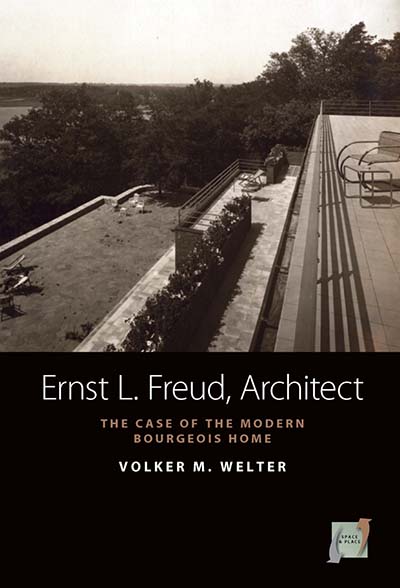
Ernst L. Freud, Architect: The Case of the Modern Bourgeois Home

by By Volker M. Welter ; photography by Volker M. Welter

What can it have been like to be architect Ernst Freud, son of a 20th-century titan (Sigmund Freud) and father of world-famous artist (the late Lucian Freud), both of whom explored disturbing psychological terrain? In addition, Freud’s life and career paralleled the upheavals of the early 20th century. He was raised in Vienna, that fin-de-siecle cauldron of Modernism, where he was privileged to the most elite cultural circles. He had a fairly conventional architectural education in Munich followed by study at Adolf Loos’ private Bauschule in Vienna, founded in 1912 as an alternative architectural program that included impassioned conversation over kaffee mit schlag. Freud’s fellows there included Modernist greats Rudolf Schindler and Richard Neutra. Neutra, who was a close family friend and his footloose traveling companion in Italy, was also his almost eerily parallel contemporary (Freud, April 6, 1892-April 7, 1970; Neutra, April 8, 1892-April 16, 1970).

Freud’s upheavals continued after moving his practice to Berlin. He narrowly escaped the Nazis in 1933 and settled with his wife and three sons in England, a land neither climatically nor culturally disposed to Modernism. Quite reasonably, one might predict he would be a tortured soul, a prescient radical, a true believer in Modernism-anything to match the turbulent times and cultural dimensions of his famed father and son.

Ernst Freud was none of those. While it would have been intriguing to learn more about the family’s personal history, architectural historian Volker M. Welter focuses on Freud’s reconciliation with modernity as a designer in his meticulously researched book. As Welter illuminates, Freud was a smoothly competent stylist not quite at home with Modernism, gravitating toward it but never disturbing the waters. Instead, Freud exemplified the tension between the primal need to recreate the stable domesticity of the past, and the headlong plunge into that pedigreed Modernism, which many of his colleagues, if not necessarily his clients, embraced.

Using a deep well of primarily German sources, Welter, Associate Professor in the Department of Art and Architecture at the University of California, Santa Barbara, introduces his subject by framing the historical context of the typically free-standing, single-family “modern” bourgeois home. Moving chronologically through Freud’s body of work, which included some of the world’s first psychoanalytic offices and clinics, the historian concludes with an aptly named chapter, “Architecture Without Quality?” Although not mentioned, the title refers to Austrian writer Robert Musil’s famous interwar A Man Without Qualities, which paints the ambiguity, lack of decision, and passivity in the face of modernity.

Welter joins other historians in unpacking Modernism as received Bauhaus wisdom, or a particular style, in favor of a constellation of individual strategies addressing modernity after the ravages of war. He examines the possible meanings in the dissonance between interior and exterior in some of Freud’s best-known German works, such as the Lampl House (1926) and the crisply detailed Frank House (1930). On the exterior, at least, the later house recalls Mies van der Rohe’s early brick-and-glass houses. Despite their large expanses of glass, however, Freud’s interiors were anything but open plan. Their numerous doors and walls upheld traditional 19th-century social hierarchies, while every fitting and finish was sleekly Moderne, rather than functionally Modern. Freud’s real talent, it seems, was in interior and especially furniture design, characterized by long, low functional built-ins. In the later English years, Freud struggled for clients, primarily winning interior commissions that delivered coolly smart-yet safe-floor plans for his bourgeois clients. Other architects in Britain, such as Berthold Lubetkin and Wells Coates, pursued a more pure Modernist agenda, and the chapter on Freud’s English practice would have benefitted by being placed in this larger context of the emergence of English Modernism.

Apart from the book’s primary thesis, a secondary theme, this one elegiac, percolates the text. This is the experience of the Jews who moved to England, accompanied by a Jewish sensibility toward the idea of “place” that added to the tension between recreating the past and the call of Modernism. This idea was articulated by none other than Sigmund Freud: “It is typically Jewish not to renounce anything and to replace what has been lost.” This statement contradicts actions of many early 20th-century Jewish figures who did indeed renounce everything, defining modernity in language, philosophy, art, and music, even though it ultimate defines those of Ernst Freud, a refiner rather than a revolutionary.

Sigmund gratefully considered his son’s skill in designing their new London home and consultation rooms as even more mysterious than the workings of the human psyche. “Sheer witches’ sorcery translated into architectural terms,” he called it. And in the spirit of Musil, the author concludes his book not by determining whether Freud’s architecture was of high or good quality, as in a standard of excellence, but in explicating quality as those elements that frame and form a series of character traits. For Freud and his clients, recreating the quality of “home” was clearly one of those elements, and an urgent one.

Berghahn Books; paperback; 214 pages; $39.95.

-Barbara Lamprecht
Svetlana Petrović

Working in support of SAH/SCC for more than twenty years, Svetlana is an art director and graphic designer living and working between Los Angeles, California and Belgrade, Serbia. She designs our quarterly newsletter and is also responsible for our beautiful new website which was created by her and her partner’s design and build agency, CATCH ME CREATIVE.

Agnie Agostino

Angie Agostino, the owner of AgostinoCreative, has been working in the multimedia industry providing graphic design, photography, social media and interactive projects for over 20 years. She has also teamed up with author Jeffrey Crider and the two of them have published several books focusing on the history of various cities in the southern California region — many, of which, have recently been added to the Library of Congress.

Julie D. Taylor, Hon. AIA

Julie is Founder/Principal of Taylor & Company, a company providing public relations and marketing services to professionals and organizations involved in architecture, design, and furnishings. A self-described “design evangelist,” she has written three books including Spa: The Sensuous Experience (2006); Bars, Pubs, and Cafes (2000); and Outdoor Rooms (1999), in addition to countless articles on design, architecture, marketing, and art. Julie has been editor of SAH/SCC News since 1998, and was the West Coast correspondent for ArchNewsNow.com. She is a frequent guest lecturer on marketing architectural services at conferences and universities. Julie is on the advisory board of USModernist, and was the co-founderof CANstruction LA. She was given honorary AIA/LA membership in December 2007 and received an Allied Professions Achievement Honor from AIA California Council in 2012. Julie was the 2014-2016 Public Director on the National AIA Board of Directors and was granted national honorary AIA status in 2018.

Lilian Pfaff

Lilian Pfaff, Ph.D. is an award-winning author, educator, curator, and real estate agent at MODERN CALIFORNIA HOUSE. She earned her Master in Art History from University of Hamburg, her Master of Advanced Studies in Architectural Theory from ETH Zuerich and her Ph.D. in Architecture History from the University of Zuerich. She is the author of J.R. Davidson (Birkhauser, 2019), Escher GuneWardena (Birkhauser, 2017), and numerous other books and articles. She is a member of the adjunct faculty at Cal Poly Pomona, Pasadena City College and Woodbury University—teaching architectural history and theory. She is a board member of the HPOZ Board Highland Park – Garvanza.

David Coffey

David Coffey is the owner of Richard Neutra’s Davis House (1937) in Bakersfield, CA, as well as the steward/caretaker of Frank Lloyd Wright’s Ablin House (1959). He has curated and produced multiple historical architecture events in Bakersfield, including “Masters of Modernism: Neutra & Wright in Bakersfield” with SAH/SCC’s Sian Winship in October 2009, and “Bakersfield Built: 1930s” in conjunction with CSUB’s celebration of the 75th anniversary of the publication of John Steinbeck’s The Grapes of Wrath.  Other programs with the Bakersfield Museum of Art, CSUB Library Special Collections Department, and the Kern County Museum to curate and produce “Bakersfield Built: 1960s” in September of 2019 and Bakersfield Built the 1950’s in September of 2024. He is working with the University of Uruguay in Montevideo on ongoing programs promoting the rich modernist building in Uruguay titled Montevideo Modernism.  He is a board member of the Bakersfield Museum of Art and is currently on its Exhibition Committee. David grew up in Cincinnati, OH, and graduated from the University of Cincinnati College Conservatory of Music with a BA in electronic media.

Jean Baaden

As a member of the SAH/SCC Board for the past twenty eight years, Sian Winship has created numerous educational programs celebrating modern residential architecture in Southern California and across the country. In 2011, Sian earned her Masters of Historic Preservation (MHP) from USC. Sian is the author of the award-winning Japanese American Context and Women’s Right’s Context for SurveyLA. She has also authored a number of successful National Register nominations including the Bakersfield Woman’s Club, A.Q. Jones Residence #3, the St. Vincent Seminary Historic District. She has researched and written historic context statements for Ventura, Bakersfield, Paramount, and was the principal author of the award-winning Long Beach Suburbanization and Race Context Statement. She is also on the board of the Neutra Institute for Survival Through Design. She is an adjunct professor in the Heritage Conservation Program at USC.

Brent Eckerman

Internet Editor

Brent Eckerman is an architect who has worked in Los Angeles for the past forty-one years. He received his architectural degree from Cal Poly Pomona. During his career, he spent many years as a Senior Associate at Frederick Fisher and Partners in Los Angeles. He currently works for the City of Los Angeles, at the Bureau of Engineering. He has an interest in Modern Architecture and particularly in Mid-Century Modernism. Brent also has a strong background in computer technology and acted as the driving force behind the SAH/SCC Website. 

Rina Rubenstien

Membership

Rina Rubenstein’s family came to Los Angeles a century ago. Her father, a landscaper who took her to his construction sites including UCLA, JPL, & Century City, instilled in her a strong connection with the built environment of Southern California. After high school, Rina moved to Israel to work on a kibbutz, milking cows and weeding cotton. While studying Biblical Archaeology & Classical Art History at the Hebrew University in Jerusalem, she worked summers on excavations and winters in the Israel Museum. Since then, she has held mostly library and information management positions. Rina was Treasurer of a SAH/SCC for several years. She lives in a 1913 Craftsman home in West Adams, where she’s active in neighborhood affairs. 

John Berley

Treasurer

John Berley has been a Board Member since 1994 and was President of the SAH/SCC from 1996 to 1999. He is a former Senior Associate at Frederick Fisher and Partners, Architects and for 14 years served as a Landmarks Commissioner for the City of Santa Monica (2003-2017). John has been responsible for rehabilitation projects including the Annenberg Community Beach House (2009), Grand Central Air Terminal (Henry Gogerty, 1930), as well as the Sunnylands Center and Gardens in Rancho Mirage.  Over the years, John has created such memorable SAH/SCC programs as On Parallel Lines: The Sarasota School of Architecture and the Case Study House Program; Creative Space: Architects Offices, and Beyond the Bauhaus: The Legacy of Walter Gropius in Boston. He is also the leader of the ongoing Modern Patrons series, which offers thoughtful dialogue with homeowners who commissioned the modern masters. Additionally, He has written on the early influence of Irving Gill, A. Quincy Jones, and the Post-War development of Modern Architecture in America.

Jay Platt

Vice President

Jay Platt is the Principal Planner for Historic Preservation with the City of Glendale Community Development Department. He is also an Adjunct Associate Professor in the Heritage Conservation program at USC.  Over the last thirty years, Jay has served in various roles in the public, private, non-profit, and education sectors in New York City, Philadelphia, and his hometown, Los Angeles.  And, most days, he’s still into it!  He received his undergraduate degree from UCLA and an M.S. in Historic Preservation from the University of Pennsylvania.  He and his wife Kathleen enjoy life in Eagle Rock with a couple of amusing beagles.

Sian Winship

President

As a member of the SAH/SCC Board for the past twenty eight years, Sian Winship has created numerous educational programs celebrating modern residential architecture in Southern California and across the country. In 2011, Sian earned her Masters of Historic Preservation (MHP) from USC. Sian is the author of the award-winning Japanese American Context and Women’s Right’s Context for SurveyLA. She has also authored a number of successful National Register nominations including the Bakersfield Woman’s Club, A.Q. Jones Residence #3, the St. Vincent Seminary Historic District. She has researched and written historic context statements for Ventura, Bakersfield, Paramount, and was the principal author of the award-winning Long Beach Suburbanization and Race Context Statement. She is also on the board of the Neutra Institute for Survival Through Design. She is an adjunct professor in the Heritage Conservation Program at USC.