SOCIETY OF ARCHITECTURAL HISTORIANS

SOUTHERN CALIFORNIA CHAPTER

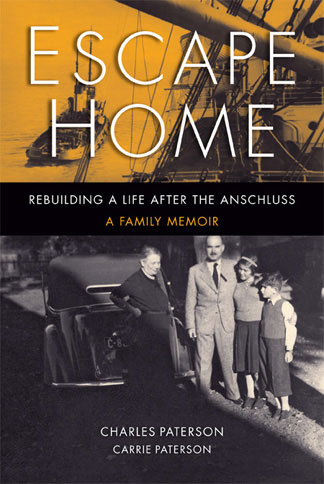
Escape Home: Rebuilding a Life after the Anschluss—A Family Memoir

by Charles Paterson and Carrie Paterson

At the end of Escape Home: Rebuilding a Life after the Anschluss—A Family Memoir, the reader will find a collection of Austrian recipes tucked away among endnotes, bibliography, and family genealogies. Among them is a recipe for Kaiserschmarren (Emperor Omelets), one of my most favorite dishes ever since I learned to love skiing as a young boy on some hillside in the Austrian Alps. So I settled down into a cozy corner of my home with a self-made, kind-of version of that kaiserliche dish, and a bottle of Grüner Veltliner (one of Austria’s best-kept secrets for fine white wine) in order to read the biography of one Austrian-Jewish family whose life was ripped apart when the National Socialist Germansmy very own ancestors, I am afraid to sayoccupied their country in 1938.

The book, written by Charles Paterson, a skiing instructor and architect in Aspen, CO, and Carrie Paterson, a Los Angeles-based writer and co-author with her father, is one of the more uplifting accounts of European émigré life that I have read in a long time. At the same time, it is a deeply nostalgic book about the domestic qualities of architecture, nowadays so often lost in favor of abstract categories, such as ethnicity, race, class, economy, or politics.

Foremost, the book recalls the fate of the Schanzer family as told through the lives of Charles Paterson, who was born as Karl Schanzer in Vienna in 1929, and his father, Stefan Schanzer (1889-1979), who changed his last name to “Shanzer” when he finally arrived in safety in the U.S. in 1941. The family fled National Socialism by moving from Austria to Czechoslovakia, and when that nation was traded in for an illusionary peace, Charles and his sister Doris were sent to Australia. There, an unknown family willingly adopted the two children just get them out of Europe. Their mother had passed away already in 1938; their father embarked on a heart rendering flight from Nazism through western Europe on a bicycle. It will touch you to tears right away, regardless of how many accounts of similar fates you believe to have studied and understood.

What does all this have to do with architecture? First, the Austrian modernist Adolf Loos was a member of the extended family. Accordingly, Charles Paterson lived during his exile in Czechoslovakia in Loosian bourgeois interiors. Second, earlier on, his family owned a house in the modernist 1932 Werkbund settlement in Vienna that was designed by Jacques Groag, himself a Jewish émigré architect in Great Britain since 1940. Third, the book is essentially about making for oneself a home, even under the most adverse circumstances. What else is architecture about, if not that? Thus, reading the book, one becomes acquainted with how Charles Paterson learned about construction in Australia, bought property in Aspen in order to self-build log cabins, studied with Frank Lloyd Wright, and eventually became an architect and erected his own ski lodge in Aspen that today is in-part a protected historic structure. Apparently, by building, he not only survived but lived, and, accordingly, perhaps one can live best by building?

If you consider architecture primarily as an art form, a monetary investment, or some abstract political act, then you will miss the relevance of this book. If, however, you think and feel architecture is about making a home for man—us, humans—on earth, then you will appreciate these tours de force of father and son that both found their happy endings in Aspen. In the case of this one family at least, “Oy vey Europa” gave way to “My home is in Aspen.” What a story of private lives. What a book!

Volker M. Welter

Volker M. Welter is a Professor in the Department of the History of Art and Architecture at the University of California, Santa Barbara, and is a Life Member of SAH/SCC.

Svetlana Petrović

Working in support of SAH/SCC for more than twenty years, Svetlana is an art director and graphic designer living and working between Los Angeles, California and Belgrade, Serbia. She designs our quarterly newsletter and is also responsible for our beautiful new website which was created by her and her partner’s design and build agency, CATCH ME CREATIVE.

Agnie Agostino

Angie Agostino, the owner of AgostinoCreative, has been working in the multimedia industry providing graphic design, photography, social media and interactive projects for over 20 years. She has also teamed up with author Jeffrey Crider and the two of them have published several books focusing on the history of various cities in the southern California region — many, of which, have recently been added to the Library of Congress.

Julie D. Taylor, Hon. AIA

Julie is Founder/Principal of Taylor & Company, a company providing public relations and marketing services to professionals and organizations involved in architecture, design, and furnishings. A self-described “design evangelist,” she has written three books including Spa: The Sensuous Experience (2006); Bars, Pubs, and Cafes (2000); and Outdoor Rooms (1999), in addition to countless articles on design, architecture, marketing, and art. Julie has been editor of SAH/SCC News since 1998, and was the West Coast correspondent for ArchNewsNow.com. She is a frequent guest lecturer on marketing architectural services at conferences and universities. Julie is on the advisory board of USModernist, and was the co-founderof CANstruction LA. She was given honorary AIA/LA membership in December 2007 and received an Allied Professions Achievement Honor from AIA California Council in 2012. Julie was the 2014-2016 Public Director on the National AIA Board of Directors and was granted national honorary AIA status in 2018.

Lilian Pfaff

Lilian Pfaff, Ph.D. is an award-winning author, educator, curator, and real estate agent at MODERN CALIFORNIA HOUSE. She earned her Master in Art History from University of Hamburg, her Master of Advanced Studies in Architectural Theory from ETH Zuerich and her Ph.D. in Architecture History from the University of Zuerich. She is the author of J.R. Davidson (Birkhauser, 2019), Escher GuneWardena (Birkhauser, 2017), and numerous other books and articles. She is a member of the adjunct faculty at Cal Poly Pomona, Pasadena City College and Woodbury University—teaching architectural history and theory. She is a board member of the HPOZ Board Highland Park – Garvanza.

David Coffey

David Coffey is the owner of Richard Neutra’s Davis House (1937) in Bakersfield, CA, as well as the steward/caretaker of Frank Lloyd Wright’s Ablin House (1959). He has curated and produced multiple historical architecture events in Bakersfield, including “Masters of Modernism: Neutra & Wright in Bakersfield” with SAH/SCC’s Sian Winship in October 2009, and “Bakersfield Built: 1930s” in conjunction with CSUB’s celebration of the 75th anniversary of the publication of John Steinbeck’s The Grapes of Wrath.  Other programs with the Bakersfield Museum of Art, CSUB Library Special Collections Department, and the Kern County Museum to curate and produce “Bakersfield Built: 1960s” in September of 2019 and Bakersfield Built the 1950’s in September of 2024. He is working with the University of Uruguay in Montevideo on ongoing programs promoting the rich modernist building in Uruguay titled Montevideo Modernism.  He is a board member of the Bakersfield Museum of Art and is currently on its Exhibition Committee. David grew up in Cincinnati, OH, and graduated from the University of Cincinnati College Conservatory of Music with a BA in electronic media.

Jean Baaden

As a member of the SAH/SCC Board for the past twenty eight years, Sian Winship has created numerous educational programs celebrating modern residential architecture in Southern California and across the country. In 2011, Sian earned her Masters of Historic Preservation (MHP) from USC. Sian is the author of the award-winning Japanese American Context and Women’s Right’s Context for SurveyLA. She has also authored a number of successful National Register nominations including the Bakersfield Woman’s Club, A.Q. Jones Residence #3, the St. Vincent Seminary Historic District. She has researched and written historic context statements for Ventura, Bakersfield, Paramount, and was the principal author of the award-winning Long Beach Suburbanization and Race Context Statement. She is also on the board of the Neutra Institute for Survival Through Design. She is an adjunct professor in the Heritage Conservation Program at USC.

Brent Eckerman

Internet Editor

Brent Eckerman is an architect who has worked in Los Angeles for the past forty-one years. He received his architectural degree from Cal Poly Pomona. During his career, he spent many years as a Senior Associate at Frederick Fisher and Partners in Los Angeles. He currently works for the City of Los Angeles, at the Bureau of Engineering. He has an interest in Modern Architecture and particularly in Mid-Century Modernism. Brent also has a strong background in computer technology and acted as the driving force behind the SAH/SCC Website. 

Rina Rubenstien

Membership

Rina Rubenstein’s family came to Los Angeles a century ago. Her father, a landscaper who took her to his construction sites including UCLA, JPL, & Century City, instilled in her a strong connection with the built environment of Southern California. After high school, Rina moved to Israel to work on a kibbutz, milking cows and weeding cotton. While studying Biblical Archaeology & Classical Art History at the Hebrew University in Jerusalem, she worked summers on excavations and winters in the Israel Museum. Since then, she has held mostly library and information management positions. Rina was Treasurer of a SAH/SCC for several years. She lives in a 1913 Craftsman home in West Adams, where she’s active in neighborhood affairs. 

John Berley

Treasurer

John Berley has been a Board Member since 1994 and was President of the SAH/SCC from 1996 to 1999. He is a former Senior Associate at Frederick Fisher and Partners, Architects and for 14 years served as a Landmarks Commissioner for the City of Santa Monica (2003-2017). John has been responsible for rehabilitation projects including the Annenberg Community Beach House (2009), Grand Central Air Terminal (Henry Gogerty, 1930), as well as the Sunnylands Center and Gardens in Rancho Mirage.  Over the years, John has created such memorable SAH/SCC programs as On Parallel Lines: The Sarasota School of Architecture and the Case Study House Program; Creative Space: Architects Offices, and Beyond the Bauhaus: The Legacy of Walter Gropius in Boston. He is also the leader of the ongoing Modern Patrons series, which offers thoughtful dialogue with homeowners who commissioned the modern masters. Additionally, He has written on the early influence of Irving Gill, A. Quincy Jones, and the Post-War development of Modern Architecture in America.

Jay Platt

Vice President

Jay Platt is the Principal Planner for Historic Preservation with the City of Glendale Community Development Department. He is also an Adjunct Associate Professor in the Heritage Conservation program at USC.  Over the last thirty years, Jay has served in various roles in the public, private, non-profit, and education sectors in New York City, Philadelphia, and his hometown, Los Angeles.  And, most days, he’s still into it!  He received his undergraduate degree from UCLA and an M.S. in Historic Preservation from the University of Pennsylvania.  He and his wife Kathleen enjoy life in Eagle Rock with a couple of amusing beagles.

Sian Winship

President

As a member of the SAH/SCC Board for the past twenty eight years, Sian Winship has created numerous educational programs celebrating modern residential architecture in Southern California and across the country. In 2011, Sian earned her Masters of Historic Preservation (MHP) from USC. Sian is the author of the award-winning Japanese American Context and Women’s Right’s Context for SurveyLA. She has also authored a number of successful National Register nominations including the Bakersfield Woman’s Club, A.Q. Jones Residence #3, the St. Vincent Seminary Historic District. She has researched and written historic context statements for Ventura, Bakersfield, Paramount, and was the principal author of the award-winning Long Beach Suburbanization and Race Context Statement. She is also on the board of the Neutra Institute for Survival Through Design. She is an adjunct professor in the Heritage Conservation Program at USC.