SOCIETY OF ARCHITECTURAL HISTORIANS

SOUTHERN CALIFORNIA CHAPTER

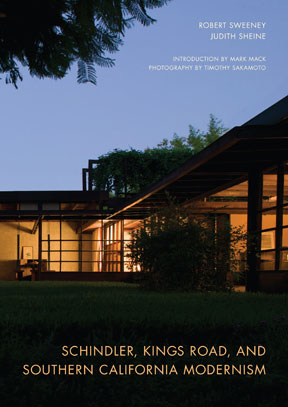
Schindler, Kings Road, and Southern California Modernism

by Robert Sweeney and Judith Sheine

Adolf Loos (1870-1933) was one of Rudolf M. Schindler’s principle influences. Loos, the Viennese theorist and architect, is widely thought to be 20th-century architecture’s most controversial figure. His scathing jeremiads on hypocrisy and ornament have generated their own torrent of interpretations, only to prove the enduring fecundity of his ideas.

But Schindler and Richard Neutra knew the man as well as the work. They gravitated to Loos because he was an original, the Classicist that Modernism can’t ignore. Both younger architects frequented the Bauschule (building school) Loos founded in 1912. Huddled over kaffee or exotic American concoctions (for his students) and curdled milk (for Loos’ stomach), he propounded his theories on the fly and conducted flâneur-esque building tours. The peripatetic teaching method would be familiar to the Stoics, and particularly apt for a school with no facilities and a Socratic faculty of one.

Schindler, especially, seized the potential of Loos’s Raumplan, in which interior spaces vary according to function and status, resulting in three-dimensional puzzles rich in complexity. Schindler interpreted this emphasis in section, rather than in plan or elevation, against a backdrop of a new country, geography, and climate.

That is the historical connection between Loos and Schindler, yet these two books differ sharply in objective and tenor. Written by the two leading scholars of his work, the Schindler monograph distills ideas in earlier, larger works by the authors, as well as in a similar book on the Kings Road House by Kathryn Smith.

Schindler, Kings Road, and Southern California Modernism has a three-part agenda. It burrows deep into the sequence of construction of the iconic 1922 Schindler-Chace house, designed as a duplex for R.M. and his wife, Pauline, and contractor Clyde Chace and his wife, Marion. Second, the book illuminates the contribution of Pauline, an unflagging activist, self-proclaimed Bolshevist, and gifted writer. Through her story a whole new house emerges, suddenly a fulcrum overflowing with people experimenting with everything from progressive education to dance. Finally, the book recasts R.M.’s importance as a far more influential Modernist than history has credited him for. In some ways this is a needed revision, but other polemical speculation warrants far further investigation, especially regarding Schindler’s possible influence on the work of Erich Mendelsohn and Mies van der Rohe. In any case, the house is a radical watershed by any criterion. The two essays flank new photography by Timothy Sakamoto, who captures the dwelling’s earthy materiality, the integration of Japanese sensibilities in the play of light and shadow, and, above all, the building’s intimacy with its setting.

Adolf Loos: A Private Portrait was written by Claire Beck Loos, the Viennese architect’s third wife. Claire, a photographer, a beauty, and a secular Czech Jewess, married-against her parents’ wishes-an aging genius, broken in health and hopeless with money, but tender, impulsive, and unforgettable. They wed in 1929, when she was 24 and he was 58. She left “Dolfi” fewer than three years later and was devastated when he wouldn’t take her back. Spoken from his sick bed, he declared: “A woman who leaves me may not come back!” Nonetheless, Loos wept at her loss to his friend, the artist Oskar Kokoschka, and she managed to see Loos before he died in a sanatorium. For the next eight years, she appears to have no permanent home. In 1941 she boarded a train for the concentration camp Terezin, was transported to Riga, and killed on her arrival.

Claire wrote the book-first published in 1936-to raise money for the tombstone Loos designed for himself. The book is so very alive with his presence, however, that surely it was a means to keep him close to her. Filled with family photographs, it was recently republished in English. Beck Loos’s niece and nephew, Janet Beck Wilson and Charles Paterson, along with his wife Fonda and their daughter Carrie compiled supplemental family commentary, helping to place the Loos couple in the context of their larger world and history.

In razor-sharp anecdotes, some a paragraph, some several pages, Claire writes in the present tense. The result is altogether Loosian: timeless, with as little ornament, but as much empathy, as any protégé could deliver. Here, theory in the flesh walks in. Claire recounts several telling moments: Loos dancing the Charleston with Josephine Baker; Loos having the foyer ceiling of the brilliant Villa Mühler (1930) painted a dark blue at the last minute to “lower” the still-too-high ceiling so that it conveyed the feeling of shelter he required. He scolds clients regularly and protects his craftsmen: “Never bargain a worker down … Give him rather a little more, and you will receive a thousand times better work.” Shocked at his wife’s letting an unattended soap cake dissolve away, he turns red: “Don’t you know that I have spent my entire life fighting against ornamentation, against the waste of energy, against the waste of material?” We do know, Herr Professor Loos. Thank you Claire Beck Loos and family, for sharing with us your exasperating, exhilarating adventure with him.

Schindler: University of California Press; hardcover; 112 pages; $39.95. Loos: DoppelHouse Press; hardcover; 200 pages; $24.95.

-Barbara Lamprecht

Barbara Lamprecht, M.Arch., is a Neutra scholar, writer, and qualified architectural historian specializing in Modern buildings
Svetlana Petrović

Working in support of SAH/SCC for more than twenty years, Svetlana is an art director and graphic designer living and working between Los Angeles, California and Belgrade, Serbia. She designs our quarterly newsletter and is also responsible for our beautiful new website which was created by her and her partner’s design and build agency, CATCH ME CREATIVE.

Agnie Agostino

Angie Agostino, the owner of AgostinoCreative, has been working in the multimedia industry providing graphic design, photography, social media and interactive projects for over 20 years. She has also teamed up with author Jeffrey Crider and the two of them have published several books focusing on the history of various cities in the southern California region — many, of which, have recently been added to the Library of Congress.

Julie D. Taylor, Hon. AIA

Julie is Founder/Principal of Taylor & Company, a company providing public relations and marketing services to professionals and organizations involved in architecture, design, and furnishings. A self-described “design evangelist,” she has written three books including Spa: The Sensuous Experience (2006); Bars, Pubs, and Cafes (2000); and Outdoor Rooms (1999), in addition to countless articles on design, architecture, marketing, and art. Julie has been editor of SAH/SCC News since 1998, and was the West Coast correspondent for ArchNewsNow.com. She is a frequent guest lecturer on marketing architectural services at conferences and universities. Julie is on the advisory board of USModernist, and was the co-founderof CANstruction LA. She was given honorary AIA/LA membership in December 2007 and received an Allied Professions Achievement Honor from AIA California Council in 2012. Julie was the 2014-2016 Public Director on the National AIA Board of Directors and was granted national honorary AIA status in 2018.

Lilian Pfaff

Lilian Pfaff, Ph.D. is an award-winning author, educator, curator, and real estate agent at MODERN CALIFORNIA HOUSE. She earned her Master in Art History from University of Hamburg, her Master of Advanced Studies in Architectural Theory from ETH Zuerich and her Ph.D. in Architecture History from the University of Zuerich. She is the author of J.R. Davidson (Birkhauser, 2019), Escher GuneWardena (Birkhauser, 2017), and numerous other books and articles. She is a member of the adjunct faculty at Cal Poly Pomona, Pasadena City College and Woodbury University—teaching architectural history and theory. She is a board member of the HPOZ Board Highland Park – Garvanza.

David Coffey

David Coffey is the owner of Richard Neutra’s Davis House (1937) in Bakersfield, CA, as well as the steward/caretaker of Frank Lloyd Wright’s Ablin House (1959). He has curated and produced multiple historical architecture events in Bakersfield, including “Masters of Modernism: Neutra & Wright in Bakersfield” with SAH/SCC’s Sian Winship in October 2009, and “Bakersfield Built: 1930s” in conjunction with CSUB’s celebration of the 75th anniversary of the publication of John Steinbeck’s The Grapes of Wrath.  Other programs with the Bakersfield Museum of Art, CSUB Library Special Collections Department, and the Kern County Museum to curate and produce “Bakersfield Built: 1960s” in September of 2019 and Bakersfield Built the 1950’s in September of 2024. He is working with the University of Uruguay in Montevideo on ongoing programs promoting the rich modernist building in Uruguay titled Montevideo Modernism.  He is a board member of the Bakersfield Museum of Art and is currently on its Exhibition Committee. David grew up in Cincinnati, OH, and graduated from the University of Cincinnati College Conservatory of Music with a BA in electronic media.

Jean Baaden

As a member of the SAH/SCC Board for the past twenty eight years, Sian Winship has created numerous educational programs celebrating modern residential architecture in Southern California and across the country. In 2011, Sian earned her Masters of Historic Preservation (MHP) from USC. Sian is the author of the award-winning Japanese American Context and Women’s Right’s Context for SurveyLA. She has also authored a number of successful National Register nominations including the Bakersfield Woman’s Club, A.Q. Jones Residence #3, the St. Vincent Seminary Historic District. She has researched and written historic context statements for Ventura, Bakersfield, Paramount, and was the principal author of the award-winning Long Beach Suburbanization and Race Context Statement. She is also on the board of the Neutra Institute for Survival Through Design. She is an adjunct professor in the Heritage Conservation Program at USC.

Brent Eckerman

Internet Editor

Brent Eckerman is an architect who has worked in Los Angeles for the past forty-one years. He received his architectural degree from Cal Poly Pomona. During his career, he spent many years as a Senior Associate at Frederick Fisher and Partners in Los Angeles. He currently works for the City of Los Angeles, at the Bureau of Engineering. He has an interest in Modern Architecture and particularly in Mid-Century Modernism. Brent also has a strong background in computer technology and acted as the driving force behind the SAH/SCC Website. 

Rina Rubenstien

Membership

Rina Rubenstein’s family came to Los Angeles a century ago. Her father, a landscaper who took her to his construction sites including UCLA, JPL, & Century City, instilled in her a strong connection with the built environment of Southern California. After high school, Rina moved to Israel to work on a kibbutz, milking cows and weeding cotton. While studying Biblical Archaeology & Classical Art History at the Hebrew University in Jerusalem, she worked summers on excavations and winters in the Israel Museum. Since then, she has held mostly library and information management positions. Rina was Treasurer of a SAH/SCC for several years. She lives in a 1913 Craftsman home in West Adams, where she’s active in neighborhood affairs. 

John Berley

Treasurer

John Berley has been a Board Member since 1994 and was President of the SAH/SCC from 1996 to 1999. He is a former Senior Associate at Frederick Fisher and Partners, Architects and for 14 years served as a Landmarks Commissioner for the City of Santa Monica (2003-2017). John has been responsible for rehabilitation projects including the Annenberg Community Beach House (2009), Grand Central Air Terminal (Henry Gogerty, 1930), as well as the Sunnylands Center and Gardens in Rancho Mirage.  Over the years, John has created such memorable SAH/SCC programs as On Parallel Lines: The Sarasota School of Architecture and the Case Study House Program; Creative Space: Architects Offices, and Beyond the Bauhaus: The Legacy of Walter Gropius in Boston. He is also the leader of the ongoing Modern Patrons series, which offers thoughtful dialogue with homeowners who commissioned the modern masters. Additionally, He has written on the early influence of Irving Gill, A. Quincy Jones, and the Post-War development of Modern Architecture in America.

Jay Platt

Vice President

Jay Platt is the Principal Planner for Historic Preservation with the City of Glendale Community Development Department. He is also an Adjunct Associate Professor in the Heritage Conservation program at USC.  Over the last thirty years, Jay has served in various roles in the public, private, non-profit, and education sectors in New York City, Philadelphia, and his hometown, Los Angeles.  And, most days, he’s still into it!  He received his undergraduate degree from UCLA and an M.S. in Historic Preservation from the University of Pennsylvania.  He and his wife Kathleen enjoy life in Eagle Rock with a couple of amusing beagles.

Sian Winship

President

As a member of the SAH/SCC Board for the past twenty eight years, Sian Winship has created numerous educational programs celebrating modern residential architecture in Southern California and across the country. In 2011, Sian earned her Masters of Historic Preservation (MHP) from USC. Sian is the author of the award-winning Japanese American Context and Women’s Right’s Context for SurveyLA. She has also authored a number of successful National Register nominations including the Bakersfield Woman’s Club, A.Q. Jones Residence #3, the St. Vincent Seminary Historic District. She has researched and written historic context statements for Ventura, Bakersfield, Paramount, and was the principal author of the award-winning Long Beach Suburbanization and Race Context Statement. She is also on the board of the Neutra Institute for Survival Through Design. She is an adjunct professor in the Heritage Conservation Program at USC.