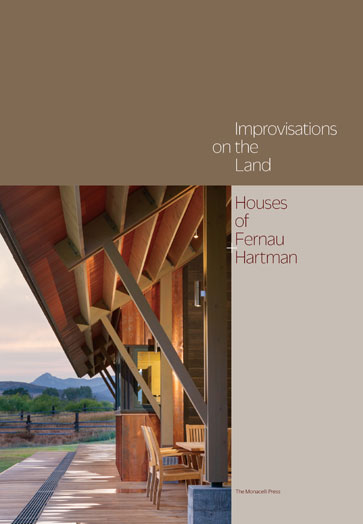
Although working in a number of project typologies, San Francisco-based firm Fernau + Hartman present residential work in their first monograph. Introductory essays by Richard Fernau, FAIA, and Laura Hartman, AIA, establish their history, outlook, and intentions for the reader, prior to investigating 18 stellar examples of homes in mostly chilly locales of Montana, Colorado, Massachusetts, and New York State, in addition to both coastal and mountain areas of California. Prolific architectural journalists Beth Dunlop, Thomas Fisher, Assoc. AIA, and Daniel Gregory also contribute commentaries.
The connection to nature is key through text and images, yet the book is generous in showing additional important influences of art, architecture, and music. Axonometric diagrams are helpful in understanding how Fernau + Hartman’s Cubist-like volumes fit together. Some photos are taken from dizzying angles, emphasizing the staccato quality of the architecture, which is akin to the improvisational jazz that Fernau admires. Gregory aptly describes the architects’ process as “lifting each major room out of its ‘packing crate’ and setting it apart.”
The firm was an early adopter of sustainable architecture, but Fernau was dismayed by how it was becoming a style, which he sees as a “contradiction for architecture that was supposed to be site- and climate-specific.” The houses, most set within beautiful sylvan sites, nevertheless emerge in an industrial aesthetic that is tempered by natural materials and playful color. Though tied to the land, the homes also exude light and air. This array of projects exhibits how the architects synthesize nature, while combining creative elements into three-dimensional collages for living.
The Monacelli Press; 192 pages; hardcover; $45.