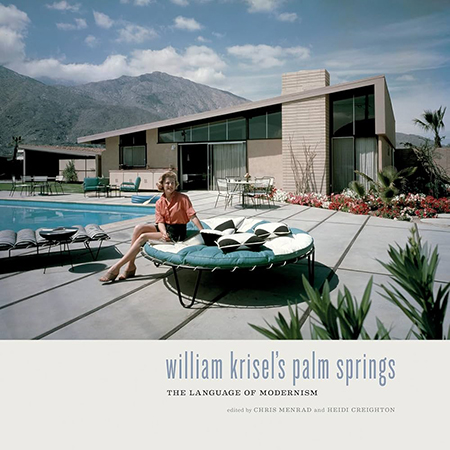
Leafing through this long-deserved volume on William Krisel, AIA, is uplifting for the display of work and spirit, and heartwarming for this writer recalling how lucky I’d been to spend just a bit of time with Bill and his wife, Corrine. I revere Bill and Corrine. I love Krisel’s work. I’m grateful for this book.
Starting with Krisel’s emphatic declaration “I am not a modern architect,” the book reveals his passion for real work for real people. His resistance to style and adherence to his philosophies refreshingly come not from ego, but from principle in service to people. He is a model architect.
Essays by many scholars familiar to SAH/SCC—including Alan Hess, Wim de Wit, Jake Gorst, SAH/SCC member Barbara Lamprecht, and our very own SAH/SCC President Sian Winship—approach the subject from various angles. Some essays are on the language of Krisel’s work and his everyday modernism, while others are about typologies or individual projects.
“Ingredients for an Extraordinary Career” is the biographical essay tracing Krisel’s unusual international upbringing, his wartime experience, USC architecture school, early work with Victor Gruen, FAIA, and the founding of several namesake firms. Throughout, one sees how his principles emerged. Recalling his time in the military, Krisel says: “I met men from all over the USA and from all walks of life…all of which I had not previously experienced. From this experience I became even more dedicated to creating well-designed modern homes for the masses.”
Krisel’s down-to-earth, populist outlook helped establish his practice as “one of the few firms in the nation that managed to bridge the worlds of architectural high design, merchant builders, and homebuyers,” writes Winship. Given Krisel’s life-long dedication to creating for the everyday person, it’s fitting that the book itself was instigated by two Krisel homeowners.
Visually, the book is replete with wonderful photos that capture the work in time, but also convey its timelessness. Plans, brochures, ads, and other ephemera are also on display. But the drawings truly captivate, and—as described by de Wit—“show a total joy of producing” and “express a feeling of excitement.”
Notes Gorst in “William Krisel, An Everyday Modernist”: “There is a movement to document the work of twentieth-century architects who worked hard and touched the lives of large populations, but who had little desire for fame. This history is being recounted with a human touch.” This book is a great step forward in documenting an architect with a particularly human touch.
Gibbs Smith; 224 pages; hardcover; $45.
—Julie D. Taylor, Hon. AIA/LA